.svg)
 Graham Charlton
How to turn quiet quitters into high performers
 Graham Charlton : 30 June 2025
Every business has them: once-energised team members who now just do the bare minimum.
Set up your first scheme, cut operational risk and keep your equity setup working as you scale.
CFOs & FDsStay audit-ready at every stageBoard-ready equity governance and reporting, with deed / witness signatures and custom document templates.
HR / People leadTurn equity into retentionMake equity visible to employees and turn it into a real retention lever.
InvestorAccess private markets with confidenceSPVs, PISCES and private-markets access, with data rooms and deal track records.
Founders, finance and people teams all rely on the same equity record - we just give each of them the view they need.
Watch a demoA short walkthrough, end to end.
Migrate to VestdDigitise or move your existing scheme
EMI, growth shares, CSOP & more
ValuationsUK HMRC & US 409A valuations
Equity management & adminGovernance, admin & filings
Fundraising - InVestd RaiseApply for S/EIS & structure your round
PISCES / secondary marketsDeploy into regulated secondary trading

If you stopped a member of your team right now and asked them how their work moves the company forward, what would they say?
For many leaders, that question lands with an uncomfortable thud. This isn’t because their people do not care, but because nobody has ever clearly shown them where they fit.
This article is about fixing that. Impact mapping is the practice of connecting every individual role to team outcomes, and every team outcome to the goals that matter most for the business.
Done well, it transforms how people show up to work. And when it is paired with an employee share scheme, it becomes something even more powerful: a clear, financially meaningful reason for every person on your team to care about what happens next.
We will walk you through what impact mapping is, why it matters more than ever, a simple framework you can use with your team, and how a well-designed share scheme can make the whole thing stick.
Impact mapping, in the context of people management, is simply the process of making the explicit connection between what someone does day-to-day and what that means for the business.
Take a customer success hire at a growing SaaS company. Their daily work might involve onboarding calls, chasing overdue check-ins, and logging feedback.
On its own, that can feel like admin, but the picture changes when the impact is clearly mapped. For example:
The concept draws on decades of research into motivation. A landmark study by Wrzesniewski and Dutton found that employees who could see how their work connected to a broader purpose reported significantly higher job satisfaction and performed at a higher level.
The tasks did not change, but the meaning did.
Impact mapping is the mechanism for creating that meaning at scale.
UK employee tenure is falling. Vestd's Employee Retention Report found that the marketing sector, one of the fastest-growing industries in the UK, now averages just 2.8 years of employee tenure, while the hospitality sector sits at 3 years.
Even in industries with historically stronger retention, the trend is pointing in the wrong direction.
The reasons are well-documented. The pandemic prompted a fundamental rethink of what work is for.
Younger workers, who now make up the majority of the workforce in sectors like marketing, retail, and hospitality, are more likely to leave roles where they do not feel they are contributing to something meaningful.
Gallup's State of the Global Workplace report consistently finds that employees who strongly agree their work is important to the company's mission are significantly more engaged and far less likely to leave.
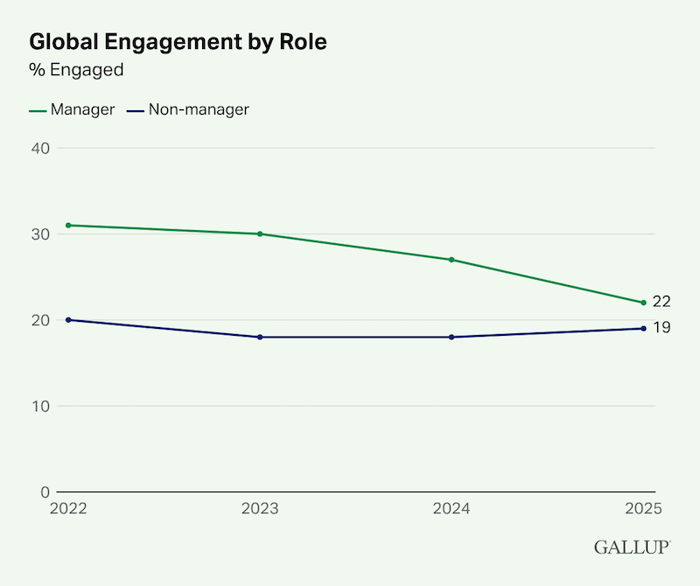
Role ambiguity is a known driver of disengagement. When people are not sure how their contribution fits, they are more likely to disengage quietly, long before they hand in their notice.
The cost of that disengagement is real. Gallup estimates that low engagement costs the global economy $8.8 trillion a year in lost productivity.
For leaders and people managers, this is not an abstract problem. A mid-level engineer or operations lead who loses clarity on their impact is a serious retention risk, and replacing them is expensive.
Research from CIPD estimates the average cost of replacing an employee in the UK at over £30,000 when recruitment, onboarding, and lost productivity are factored in.
You do not need a consultant or a two-day offsite to do this well.
The framework has three levels, and the most valuable part is not the document you produce. It is the conversation.
Level 1: Company goals
Start at the top. What does the business need to achieve in the next 12 to 18 months?
Be specific about revenue targets, funding milestones, market expansion, a key product launch. If your leadership team cannot agree on three to five clear goals, that is the first thing to fix before anything else.
Level 2: Team outcomes
For each company goal, identify what each team needs to deliver for it to happen. This is where cross-functional thinking becomes important.
Sales hitting a revenue target requires marketing to generate qualified pipeline, which requires product to have shipped something worth selling.
Map those dependencies. They are often invisible, but making them visible changes how teams relate to each other.
Level 3: Individual role contribution
For each person, work out the specific output or behaviour that drives the team outcome. This does not need to be a complex performance framework.
A sentence or two is enough: "Your role in reducing churn directly supports our ARR target, which is what we need to hit before Q3."
That is clarity and purpose, and most employees have never heard anything like it from their manager.
Run this as a short workshop with your leadership team first, then ask managers to have the individual conversation with each direct report.
The goal is not a polished document pinned to a wall. It is a shared understanding that gets refreshed regularly, ideally in quarterly check-ins.
Impact mapping is a powerful tool on its own, but something interesting happens when you add a well-designed employee share scheme to the mix.
The three levels of the map stop being theoretical and start feeling personal.
When someone holds options in a share scheme, they are not just financially invested in the company's success, they are emotionally invested.
They care about where the business is headed, because if it does well, their shares are worth more. That kind of buy-in makes the impact map feel urgent, not just interesting.
The numbers back this up. Over 50% of respondents in a survey conducted by Vestd and 3Gem said that their share scheme had improved team alignment.
42% of founders said they launched a scheme specifically to align their teams. Almost everyone surveyed said it had enhanced company culture.
These outcomes are the direct result of giving people a stake in what they are helping to build.
One important caveat: keep performance conditions simple. Adding too many conditions, or setting targets that are poorly defined, can confuse people or create competition that is not in the company's best interests.
The conditions should be specific, measurable, and clearly communicated. If employees do not understand what they need to do to earn their shares, the scheme loses its power entirely.
Vestd's own data shows that 95% of customers agree their share scheme has helped with retention.
A scheme that is well-designed and well-communicated is one of the highest-return investments a growing business can make in its people.
The case for impact mapping is ultimately a case for respect. Respect for the people on your team, and for their need to understand why their work matters.
Most employees do not leave because of a salary gap, but because they feel invisible, or purposeless, or disconnected from the thing they are spending most of their waking hours on.
Impact mapping gives people a reason to care about the company's goals. A share scheme gives them a reason to stay until those goals are reached. Together, they create something that no ping-pong table or flexible Friday policy can: a team that genuinely feels part of the story.
If you are thinking about launching a share scheme, or want to understand how to design one that actually drives alignment, book a demo with Vestd and one of our team will walk you through how to build a scheme that fits your goals.

Graham Charlton : 30 June 2025
Every business has them: once-energised team members who now just do the bare minimum.

Graham Charlton : 22 September 2025
A role charter isn’t just a job description. It’s a tool that links an individual’s work to your company’s mission, KPIs, and strategy.

Graham Charlton : 14 July 2025
Hiring the wrong person isn’t just a headache. It’s a costly mistake, and not just in terms of salary. The ripple effects of a bad hire can hurt...