

















PISCES: private secondary markets
A new way to access liquidity without going public
What is PISCES?
The Private Intermittent Securities and Capital Exchange System.
PISCES is a new UK market framework for buying and selling shares in private companies.
This hub is designed as a starting point. From here, you can explore what PISCES is, who it's for, and how Vestd supports companies and investors before, during and after a PISCES event.
Watch this space!
Choose your path
The PISCES framework benefits both companies and investors...
Test investor demand, establish a credible market-backed valuation, and provide controlled liquidity for shareholders and option holders without committing to a full IPO.
Access private company opportunities at scale, deploy larger tickets, pool capital efficiently, and participate in deals that would otherwise be impractical or out of reach.
Diversify beyond public markets, access curated private company opportunities, and invest alongside professional structures that reduce administrative complexity.
Typical use cases
Pre-IPO and growth-stage private companies exploring future raises, exits or secondary sales, particularly where traditional markets feel premature, restrictive or overly investor-led.
Explore:
Typical use cases
For micro VCs and family offices, PISCES opens up a formal route into private company secondaries. If a promising company isn't fundraising but someone wants to sell, it's a clean way in.
Investors can also take partial exits without waiting for an IPO or acquisition. Useful for returning capital to LPs or rebalancing exposure to a specific company.
Typical use cases
For HNW and sophisticated investors, PISCES opens up a regulated route into private company secondaries that may otherwise require the right connections to access.
Angels and early backers can also use PISCES to achieve partial liquidity at predictable intervals, rather than waiting indefinitely for an exit.
Where we come in
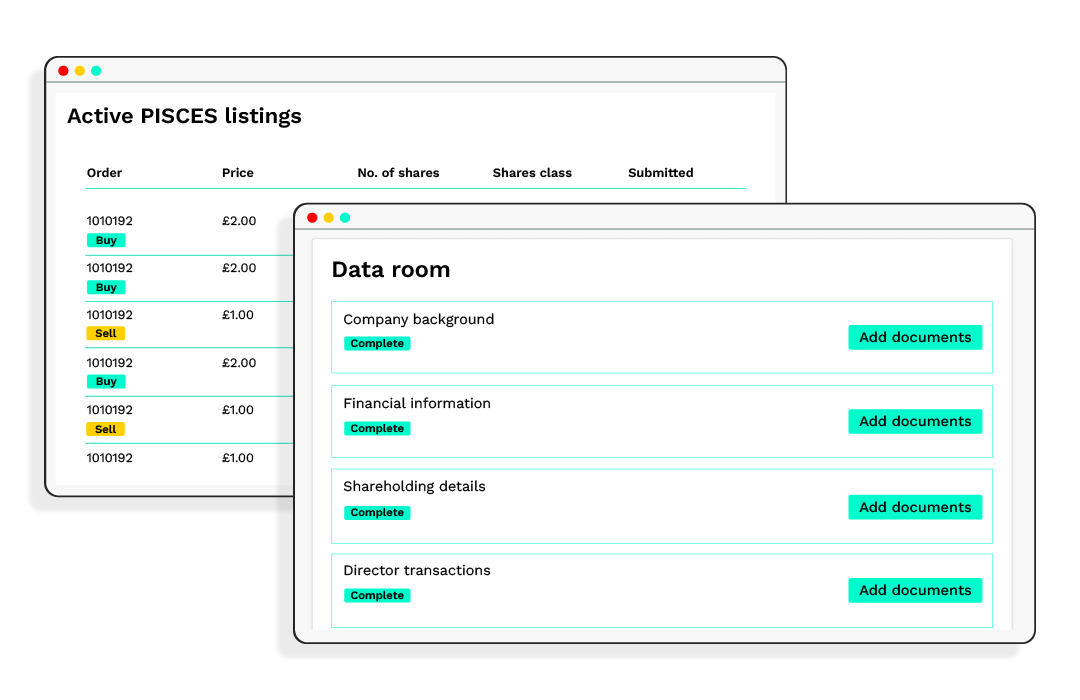
Vestd supports companies and investors with the tools, structures and workflows needed to participate in PISCES confidently and compliantly.
Our role includes:
- Equity and shareholder management for PISCES-ready companies
- SPVs and nominee structures for pooled investment
- Cap table accuracy and transaction readiness
- Providing support for ongoing compliance plus reporting features.
PISCES for companies
-
What is PISCES trading?
PISCES (Private Intermittent Securities and Capital Exchange System) is a new type of FCA-regulated share trading platform that allows buyers and sellers of shares in private companies to trade during scheduled, intermittent trading windows.
It's NOT a stock market listing. It sits in the middle ground, giving private companies a structured, government-backed way to create liquidity for their shareholders without going public.
-
Is PISCES live yet?
PISCES is currently operating as a sandbox. This will run for up to five years, during which the Treasury will assess its effectiveness before any permanent legislation is introduced. The first trading events are expected to follow as FCA-authorised operators receive approval.
-
Which companies can use PISCES?
PISCES is designed for private companies, typically growth-stage businesses that want to offer shareholders a route to liquidity without pursuing an IPO or a full sale.
Companies retain significant control: they can decide when trading events take place, who is allowed to buy their shares, and what information is disclosed and to whom.
-
As a private company, what control do I retain?
Significant control. You can determine the timing of trading events, set price parameters, screen or restrict buyers, and decide what additional information to provide beyond the core disclosures.
No new shares are issued through PISCES, so your equity structure is not diluted. You can also engage an "ask model", where investors submit specific information requests, rather than making broader voluntary disclosures.
-
How does a PISCES trading event actually work?
Trading happens through an FCA-authorised platform operator, typically using an auction mechanism.
Operators publish the price at which trades would be matched and the volume of potentially executable trades, supporting price discovery.
Events are intermittent rather than continuous, and companies can restrict which investors are permitted to participate, for example to protect their cap table or exclude competitors.
-
Do I need a valuation to run a PISCES trading event?
Not necessarily, but it's worth thinking about carefully.
PISCES uses an auction mechanism to help establish a market price, so there's no formal valuation requirement.
However, past PISCES trades may be used by HMRC as evidence of share value, which could have implications for any existing share schemes.
If you run an EMI or CSOP scheme, it is worth ensuring your valuations are up to date before participating in a trading event.
If in doubt, seek professional advice.
PISCES for investors
-
How are deals structured under PISCES?
Trading takes place through an FCA-authorised platform operator during scheduled windows rather than continuously.
The typical mechanism is an auction, where the operator publishes the matched price and volume of executable trades. Only existing shares can be sold, no new shares are issued.
Companies can set price parameters and restrict which investors can participate, and trades are placed through regulated intermediaries rather than directly with the platform.
-
Who is eligible to participate in PISCES?
PISCES is not open to the general public.
Buyers must qualify as a "specified PISCES investor", which covers professional clients, high-net-worth individuals and companies, sophisticated investors, and trustees or employees of the relevant company's share schemes.
On the sell side, founders, early investors and employees with existing shareholdings can all sell shares through a trading event.
-
What information will investors receive before trading?
Companies must share a core set of disclosures with all participating investors ahead of each trading event. This is deliberately lighter than a public market prospectus, with no requirement to include sustainability data or financial forecasts.
Commercially sensitive information can be omitted in exceptional circumstances, provided the omission is flagged and explained. Disclosures are only visible to event participants and are not made public.
-
Are there any tax benefits to trading through PISCES?
Trades executed through PISCES are exempt from the 0.5% stamp duty that normally applies to private share transfers in the UK, which is a direct cost saving for buyers.
Beyond this, the tax treatment of any gains will depend on individual circumstances, including how shares were originally acquired, for example, through an EMI or CSOP scheme. You should seek independent tax advice.
-
Are there any safeguards or protections in place?
Several. Access is restricted to eligible investors only, so general retail investors cannot participate. Disclosures must be shared with all participants simultaneously and in advance of trading.
The criminal market abuse regime under the Financial Services Act 2012 applies, and both the Financial Ombudsman Service and FSCS protections are in place.
New retail clients also benefit from a 24-hour cooling-off period, and intermediaries must ensure investments are appropriate for the client before promoting or distributing PISCES shares.
AS SEEN IN THE MEDIA
THE SHARETECH PLATFORM
See Vestd in action
Watch the video to take a closer look or book a guided demo.

