Skip to the main content.
The sharetech platform

Manage your equity and shareholders

Share schemes & options icon

Share schemes & options

Give key people some skin in the game

Equity management icon

Equity management

Powerful tools and automations

The sharetech platform

Launch funds, evalute deals & invest

SPV icon

Special Purpose Vehicles (SPV)

Create a syndicate or fund

Manage icon

Manage your portfolio

Add and monitor your investments

The sharetech platform

Predictable pricing and no hidden charges

Startups icon
SME icon

For scaleups & SMEs

Build and retain a winning team

Enterprise icon

For larger companies

Streamline equity management

The sharetech platform

Ideas, insight and tools to help you grow

Learn icon

3 min read

How to make ownership visible in cross-functional teams

How to make ownership visible in cross-functional teams
5:56

Ownership is often the first casualty of growth. When a team is five people in a single room, everyone knows who is holding the ball, but as you cross the threshold into multiple functions, specialised roles, and remote silos, that clarity evaporates.

Murky ownership can be a significant drain on your bottom line, as well as a headache.  

Research suggests that while highly structured teams achieve the best results, a staggering 78% of organisations report their cross-functional teams are only ‘a little or somewhat structured’ 

This accountability vacuum leads to a cycle of endless meetings and feedback loops where 84% of specialists feel they are spinning their wheels. 

By the end of this post, you’ll understand why traditional ownership structures fail as you scale and, more importantly, how to implement visual tools that restore clarity without resorting to micromanagement.

Why ownership breaks down

Ownership fails because the spaces between departments get wider. In a small startup, everyone is a generalist. As you hire specialists, you create handoff points. Every handoff point is a potential trapdoor where a task can disappear.

The problem is often exacerbated by what experts call network effects. As people engage in tasks outside their primary expertise, the probability of disengagement spreads like a contagion if they don't feel supported or clear on their role. 

This creates a ‘bystander effect’ where everyone assumes someone else is handling the critical detail.

The cost of murky ownership:

  • Collaboration drag: 84% of employees experience drag from excessive meetings and unclear authority (Taggd, 2025).

  • Productivity drain: Team conflicts and role confusion can lead to a 25-30% reduction in productivity.

  • The trapdoor effect: Specialised silos create handoff points where accountability is easily lost.

Beyond RACI: visual tools for the modern era

For decades, the RACI matrix (Responsible, Accountable, Consulted, Informed) was the gold standard. 

However, in a fast-moving business, RACI often becomes a compliance exercise rather than a living tool.

It can lead to decision-making bottlenecks where too many people feel they must agree to every minor tweak. 

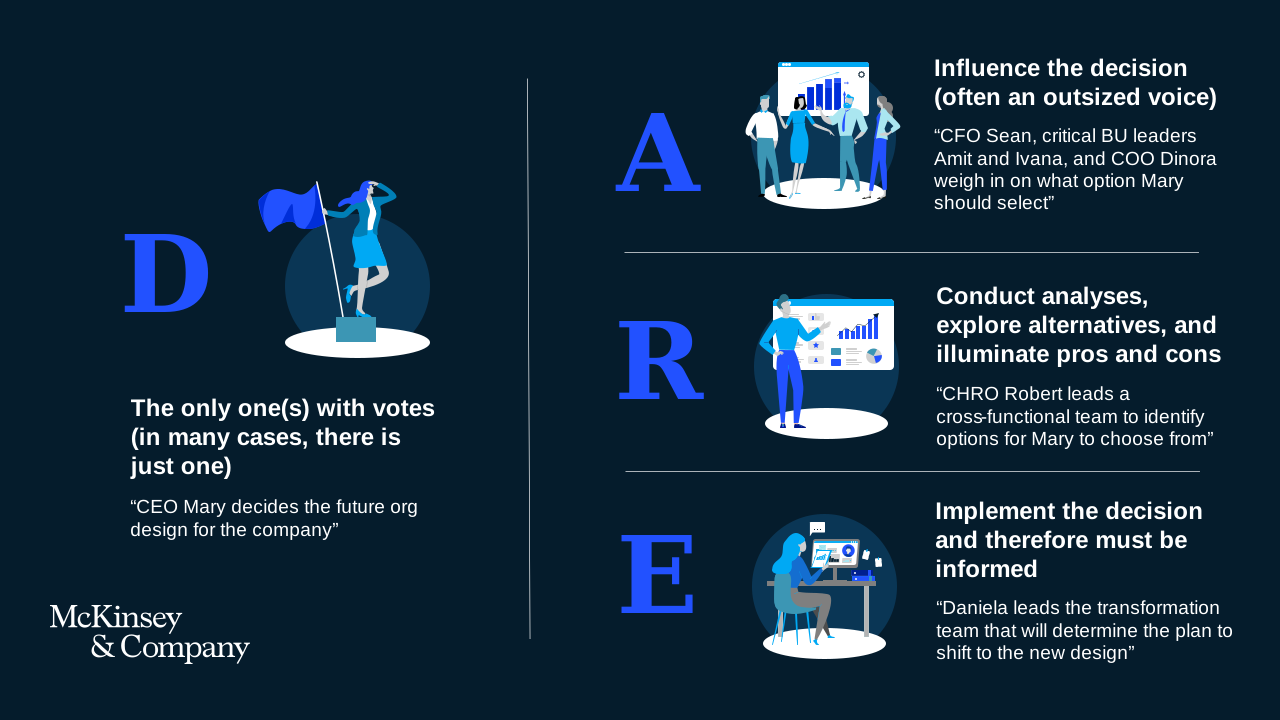
The DARE framework

There is a more dynamic alternative framework called DARE, which separates those who do from those who advise. 

  1. Deciders. The only ones with a vote. Ideally, just one person to prevent a stalemate.
  2. Advisors. They have a voice and outsized influence, but cannot delay a decision by demanding more data.
  3. Recommenders. The ones who do the heavy lifting, analyse options, and present the "pros and cons."
  4. Execution stakeholders. The people who must carry out the decision and need to be informed early to spot challenges.

McKinsey DARE

(Source: McKinsey, 2025).

Ownership canvases

For cross-functional projects, a Team Canvas is often more effective than a spreadsheet. It visualises the shared goals, individual roles, and, crucially, the social contract of how the team will communicate. 

This move to autonomous agile teams has been shown to deliver results faster and at lower costs in large-scale transformations.

Avoiding turf wars 

When ownership isn't visible, departments start to optimise for their own benefit rather than the organisation's goals. 

This is where turf wars can begin. If a Marketing team's KPIs are at odds with a Sales team's metrics, they will naturally hoard information to protect their departmental ‘win.’

Research shows that high competition within teams often leads members to withhold knowledge on purpose, treating it as an individual asset rather than a collective one.

How visibility stops the war:

  • Shared metrics. Use OKRs (Objectives and Key Results) that require two or more departments to win together.

  • Radical transparency. Use tools like Monday.com or Asana to make the backlog visible to everyone. When everyone sees the workload, turf wars are replaced by resource empathy.

  • The ‘One Accountable’ rule. Every task must have exactly one person who is ultimately accountable. As the saying goes, if everyone is responsible, no one is.

Key Takeaways: reducing conflict

  • End knowledge hiding. High-competition environments lead to information hoarding. 

  • Unify KPIs. Cross-functional success requires metrics that span departmental silos.

  • The accountability rule: Ensure every project has one clear owner. 

Autonomy vs. micromanagement

The biggest fear leaders have when letting go is losing control. However, visibility is the bridge that allows for autonomy without micromanagement.

When a leader can see the progress and the owner of a task in a centralised hub, they don't need to send the Slack message to check in. 

That message is the death of autonomy. According to Gallup, only 47% of employees strongly agree that they know what is expected of them. Visibility solves this expectation gap.

As the legendary management expert Peter Drucker once said: "Management is doing things right; leadership is doing the right things".  

Visibility allows leaders to focus on the right things (vision and strategy) while empowering the team to do things right (execution).

Summary

To maintain clarity as you grow, you must ensure visibility. 

  1. Ditch the spreadsheet. Use visual platforms that show the who and when in real-time.
  2. Adopt DARE over RACI. Streamline decision-making by limiting who actually has a vote.
  3. Humanise the process. Ensure that every handoff is a conversation, not just a notification.

Making ownership visible is about giving your team the tools and autonomy they need. Speaking of ownership...

Vestd helps growing companies align people, incentives, and long-term value. Book a call to explore how share schemes promote ownership culture.

What really drives employees to stay or quit: stats

What really drives employees to stay or quit: stats

Why do people really leave their jobs? It’s not always about pay. It can also be about factors such as work environment and opportunities for...


Read More
Why role clarity and impact matter more than ever

Why role clarity and impact matter more than ever

Unclear roles are one of the most overlooked culture killers in business.

Read More
How better career conversations unlock growth and loyalty

How better career conversations unlock growth and loyalty

When employees quit, it’s rarely just about pay.

Read More