.svg)
 Graham Charlton
Founders: Don’t fall in love with fake progress
 Graham Charlton : 03 July 2025
Founders love dashboards, but let’s be honest, half the numbers are noise, and the rest just confirm what we want to believe.
Set up your first scheme, cut operational risk and keep your equity setup working as you scale.
CFOs & FDsStay audit-ready at every stageBoard-ready equity governance and reporting, with deed / witness signatures and custom document templates.
HR / People leadTurn equity into retentionMake equity visible to employees and turn it into a real retention lever.
InvestorAccess private markets with confidenceSPVs, PISCES and private-markets access, with data rooms and deal track records.
Founders, finance and people teams all rely on the same equity record - we just give each of them the view they need.
Watch a demoA short walkthrough, end to end.
Migrate to VestdDigitise or move your existing scheme
EMI, growth shares, CSOP & more
ValuationsUK HMRC & US 409A valuations
Equity management & adminGovernance, admin & filings
Fundraising - InVestd RaiseApply for S/EIS & structure your round
PISCES / secondary marketsDeploy into regulated secondary trading

How to choose signals that drive real progress, not false confidence.
Leaders love the idea of a single, unifying metric. One number that cuts through dashboards, aligns the team, and tells you if you’re making progress.
That is what a North Star metric is meant to do.
In practice, many North Star metrics quietly mislead. They trend in the right direction, look impressive in investor updates, and create a sense of momentum.
Underneath, however, they often fail to answer the questions that actually matter: are customers getting real value, and is the business becoming stronger over time?
This article explains why so many North Star metrics fail, how to spot vanity metrics in disguise, and how to design North Stars that reflect genuine value creation. It also shows how and when to revise your North Star as the company evolves.
A North Star metric is meant to be useful. At its best, it creates a direct line between customer value and company success.
If the metric improves, customers are better off in a meaningful way, and the business becomes more likely to grow sustainably as a result.
That means a true North Star metric should do three things at once:
This is where many companies go wrong. They treat the North Star as a reporting metric rather than a behavioural one. If it does not change what teams prioritise, what gets built, or what gets deprioritised, it is not doing its job.
A good North Star should occasionally make leadership uncomfortable. That discomfort is often a signal that the metric is telling the truth.
A North Star metric exists to shape behaviour and decisions, not just to summarise performance.
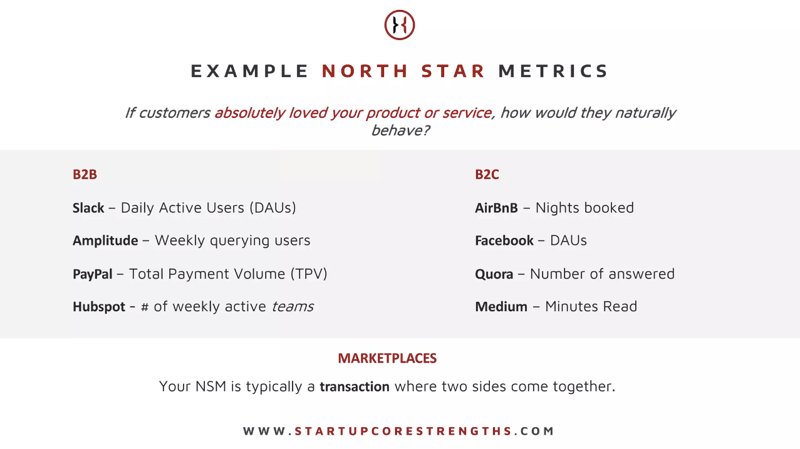
Most misleading North Star metrics are chosen for understandable reasons.
They are easy to measure. They already exist in analytics tools. They move quickly. They provide early validation when confidence is fragile and pressure is high.
The problem is that convenience rarely correlates with truth.
Companies often default to metrics that capture activity rather than impact. Sign-ups feel like growth. Downloads feel like demand. Revenue feels definitive.
However, none of these tell you whether customers are succeeding or whether the business is compounding value.
There are a few recurring patterns behind bad North Stars:
As Matt Lerner regularly highlights in his writing, many so-called growth problems are actually measurement problems. Teams execute well against the wrong goal, then wonder why results plateau.
If your North Star makes you feel confident but does not change hard decisions, it is probably misleading.
Some metrics are not inherently bad, but are often promoted to North Star status when they should not be.
Common examples include:
These numbers can be useful inputs or diagnostic signals. The issue arises when they are treated as proxies for value creation.
For example, user growth without engagement tells you nothing about whether the product is solving a real problem.
Revenue growth without retention can hide churn, discounting, or unsustainable acquisition tactics. Headcount growth can feel like momentum while quietly introducing complexity and inefficiency.
A useful rule of thumb is this: if the metric can be improved without improving the customer experience, it is a dangerous North Star.
Essentially, a North Star should be hard to move without delivering real customer value.
Despite differences in business models, strong North Star metrics share a set of underlying characteristics.
They tend to be:
Growth practitioners often describe the best North Stars as scaled versions of the customer’s ‘aha moment’. That is the point at which a user experiences enough value to justify coming back.
As Matt Lerner argues, growth accelerates when companies identify this moment and optimise for more people reaching it, more quickly, and more consistently.
In practice, this might look like:
These metrics do not just count users. They measure success.
The closer your North Star is to customer success, the more reliable it becomes.
One of the most damaging assumptions founders make is that a North Star metric should remain fixed forever. In reality, North Stars are stage-dependent. A metric that is healthy at seed stage can become actively misleading at scale.
At this stage, the priority is learning whether you are solving a real problem. Strong North Stars here often focus on:
Revenue is usually a lagging signal at this point. Obsessing over it too early can mask weak product-market fit.
Once demand is validated, the focus shifts to repeatability. North Stars at this stage often centre on:
Growth without retention is not success. It is borrowed time.
As the business matures, the North Star often needs to reflect quality and efficiency. Examples include:
If your business has changed but your North Star has not, misalignment may be setting in.
Many founders resist changing their North Star because they fear confusion or loss of focus. In reality, clarity erodes faster when metrics are left unchanged despite shifting realities.
A healthy evolution process includes:
Metrics are tools, not commitments. When they stop producing good decisions, they should be replaced.
The mistake is not changing your North Star. The mistake is pretending it still works.
Before committing to a North Star, pressure-test it with a few direct questions:
If the answers are vague, defensive, or overly qualified, keep digging. A strong North Star should survive uncomfortable scrutiny.
Metrics shape behaviour. Teams build what gets measured. Leaders reinforce what gets praised.
A misleading North Star quietly trains the organisation to optimise for the wrong things. Over time, this leads to bloated products, burnt-out teams, and cultures that prioritise optics over outcomes.
For founders, this is not just an analytics issue. It is a leadership responsibility.
Your North Star metric is a cultural signal, not just a growth lever.
One useful way to pressure-test any theory about North Star metrics is to look at what experienced founders actually use in practice.
On Vestd’s regular podcast FounderMetrics, our guests consistently describe North Stars that are tightly linked to value creation rather than dashboards, vanity signals, or surface-level growth.
A few examples illustrate how this plays out across different business models.
Trevor Stevenson-Platt, founder of the Business Growth Institute, focuses on how efficiently a business turns assets into returns.
Using the DuPont formula, he connects the balance sheet and the profit and loss statement to assess how well assets are performing and how much income they generate.
“When viewed through this lens, financial structure becomes a leading indicator rather than a lagging one, revealing whether the underlying engine of the business is genuinely strengthening”
For consumer brands, repeat behaviour often tells a clearer story than topline growth. John Stapleton, co-founder of New Covent Garden Soup and Little Dish, points to rate of sale as the metric that cuts through noise.
Repeat purchases show whether customers are genuinely choosing the product again, not just trying it once. Without that signal, other metrics lose their meaning, however positive they appear.
For David B. Horne, founder of Add Then Multiply, the North Star is not a single number but a disciplined set of financially rigorous measures.
“For me, the key metrics to measure success are clear: revenue growth, profit margins, cash conversion, and valuation uplift.”
In SaaS, clarity often comes from refusing to overcomplicate. Jonny Plein, co-founder of YASO, is explicit that revenue is the North Star, for both the business and its investors.
“YASO exists to make money for its brands. If customers are making money, they stay and scale. If they are not, they leave. That single metric keeps incentives aligned and avoids distraction.”
In financial services, trust and commitment are often better indicators of value than activity alone. Felicia Hjertman, founder of TILLIT, uses net cumulative flows as her North Star.
By tracking all money flowing into and out of the platform, the team can see whether customers genuinely value the service and are willing to keep their money there.
This metric directly informs pricing, product decisions, and long-term strategy because it reflects real customer belief, not just intent.
“Net cumulative flows tell us whether people truly value our service.”
Taken together, these examples highlight a consistent pattern. Strong North Star metrics differ by sector and stage, but they share a refusal to hide behind abstraction.
Each one is hard to inflate, closely tied to customer outcomes, and informs real decisions.
That is ultimately the role of a North Star metric. Not to reassure or impress, but to tell the truth.
The best North Star metrics should provide clarity.
They surface friction early. They expose weak retention. They force better conversations about value and priorities. That is precisely why they work.
If your North Star never challenges your assumptions, it is probably not doing its job.
Audit your current North Star. Ask what it truly measures, what it hides, and whether it still reflects how your company creates value today.
An employee share scheme, managed through Vestd, is one way to link your company’s success directly to your team’s rewards and to turn growth into a shared goal.
Book a call to find out how.

Graham Charlton : 03 July 2025
Founders love dashboards, but let’s be honest, half the numbers are noise, and the rest just confirm what we want to believe.

Graham Charlton : 22 December 2025
How to navigate the tension between personal identity and business identity as your company scales.

Graham Charlton : 13 October 2025
Most companies think they have a messaging problem, but in reality they have a positioning problem.