




The five mistakes UK businesses make when it comes to their equity
Common mistakes we see business owners make with their company's equity and how to avoid them. And links to resources to help you make smart choices.

Founders, finance and people teams all rely on the same equity record - we just give each of them the view they need.
Watch a demoA short walkthrough, end to end.
Migrate to VestdDigitise or move your existing scheme
EMI, growth shares, CSOP & more
ValuationsUK HMRC & US 409A valuations
Equity management & adminGovernance, admin & filings
Fundraising - InVestd RaiseApply for S/EIS & structure your round
PISCES / secondary marketsDeploy into regulated secondary trading
Your question is ready. Press Enter in the chat to send it.
Vestd AI isn't available right now
Please try again in a little while, or search our resources instead.
1 min read
Simon Telling
:
Updated on August 13, 2024
Usually, at some point in your business’ life, you will be after investment. It can mean an exciting step forward for your business, and your team.
But, as with many things in the entrepreneurial world, there are certain things you need to consider first. Particularly, how investment rounds will impact your equity.
Our investment round calculator will help you figure out that impact.
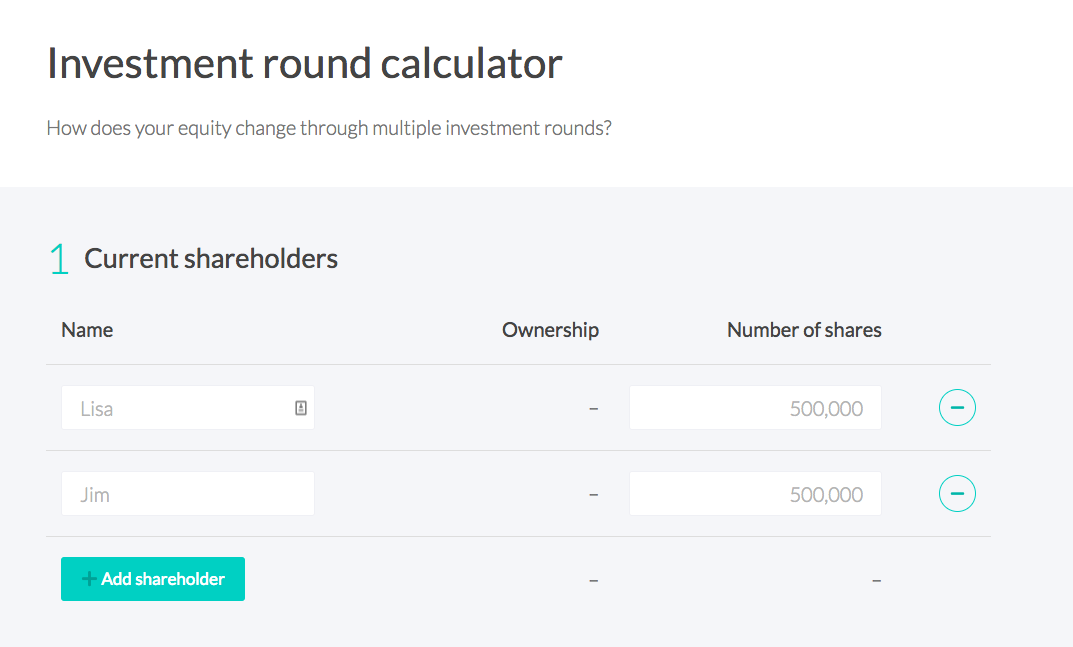
To do this you first need to know the details of your shareholders and the number of shares they currently hold. Enter that in and the calculator will tell you what that means in terms of percentage.

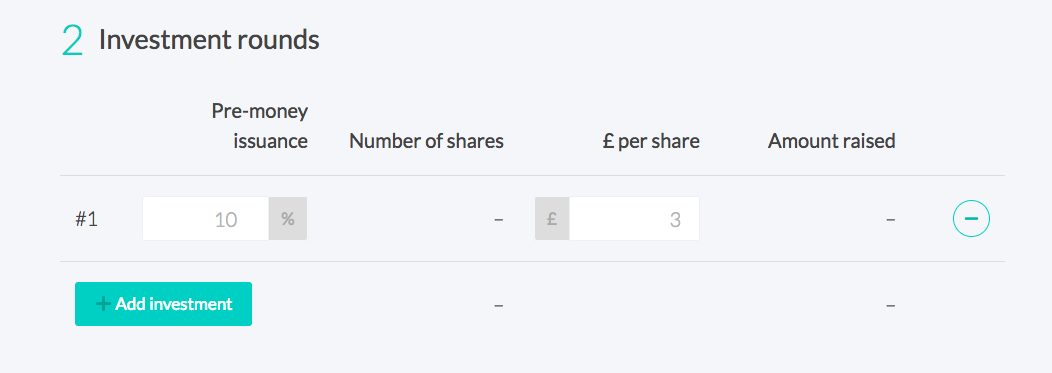
Next, you add the details of your investment round. You need to know the percentage of new equity you will issue and the cost per share.
Once you’ve entered that information, the calculator will tell you what that means in number of shares you’ll need to issue, and the amount of investment you’ll get in return.
You can add as many investment rounds as you want to see the impact of multiple rounds.

The final section of the calculator is the results.
From the information you’ve entered the calculator can tell you how the investment rounds have impacted the percentage owned by your original shareholders and how many shares you need to distribute in return for the amount of investment you need.

A. Hopefully, you’ve been a savvy and sensible business owner who has already shared ownership with your team and maintained an organised and flexible cap table.
This means you already have a structure with multiple shareholders and probably some of those are early investors.
So, when you go for another investment round and gain more shareholders, what happens to the shares the original shareholders have?
Are they diluted? If so, by how much? And the even bigger question is, what’s the impact of multiple investment rounds?
B. We’ve mentioned multiple investment rounds because it’s more than likely you’ll need more than one. But how many you need and at what price is a tricky set of calculations, that few have the time and patience for.
By using this calculator you can easily do two things.
Model existing share ownership and the impact of multiple future investment rounds on your equity (and that of other early investors).
Model the number of shares you will need to issue (and at what price) to achieve your overall investment requirements.
So what’s stopping you? Use the investment round calculator now.
Common mistakes we see business owners make with their company's equity and how to avoid them. And links to resources to help you make smart choices.
The difference between co-operatives, employee-owned businesses and a company share scheme. Employee ownership in the UK is on the rise. Is it right...
Not all capital is equal. Understand what angels, VCs, and family offices look for and how to choose the right investor for your business stage.