Common valuation mistakes (and how to avoid them)
Valuing your business is one of the most important steps when seeking investment, offering equity to employees, or approaching an exit. Yet, many...

Set up your first scheme, cut operational risk and keep your equity setup working as you scale.
CFO / FDStay audit-ready at every stageBoard-ready equity governance and reporting, with deed / witness signatures and custom document templates.
HR / People leadTurn equity into retentionMake equity visible to employees and turn it into a real retention lever.
InvestorAccess private markets with confidenceSPVs, PISCES and private-markets access, with data rooms and deal track records.
Founders, finance and people teams all rely on the same equity record - we just give each of them the view they need.
Watch a demoA short walkthrough, end to end.
Migrate to VestdDigitise or move your existing scheme
EMI, growth shares, CSOP & more
ValuationsUK HMRC & US 409A valuations
Equity management & adminGovernance, admin & filings
Fundraising - InVestd RaiseApply for S/EIS & structure your round
PISCES / secondary marketsDeploy into regulated secondary trading
Table of Contents
As a founder, you’ve probably come across terms like “pre-money valuation” and “discounted cash flow” in conversations about your company’s worth.
Whether you’re preparing for a funding round or planning to sell shares, nailing down an accurate valuation is essential—not just for transparency, but for building trust with stakeholders.
But to get there, it’s crucial to understand the key terms and factors that shape these valuations. So, what do these phrases actually mean? And how can mastering them empower you to make smarter decisions and confidently grow your business?
Let’s dive in.
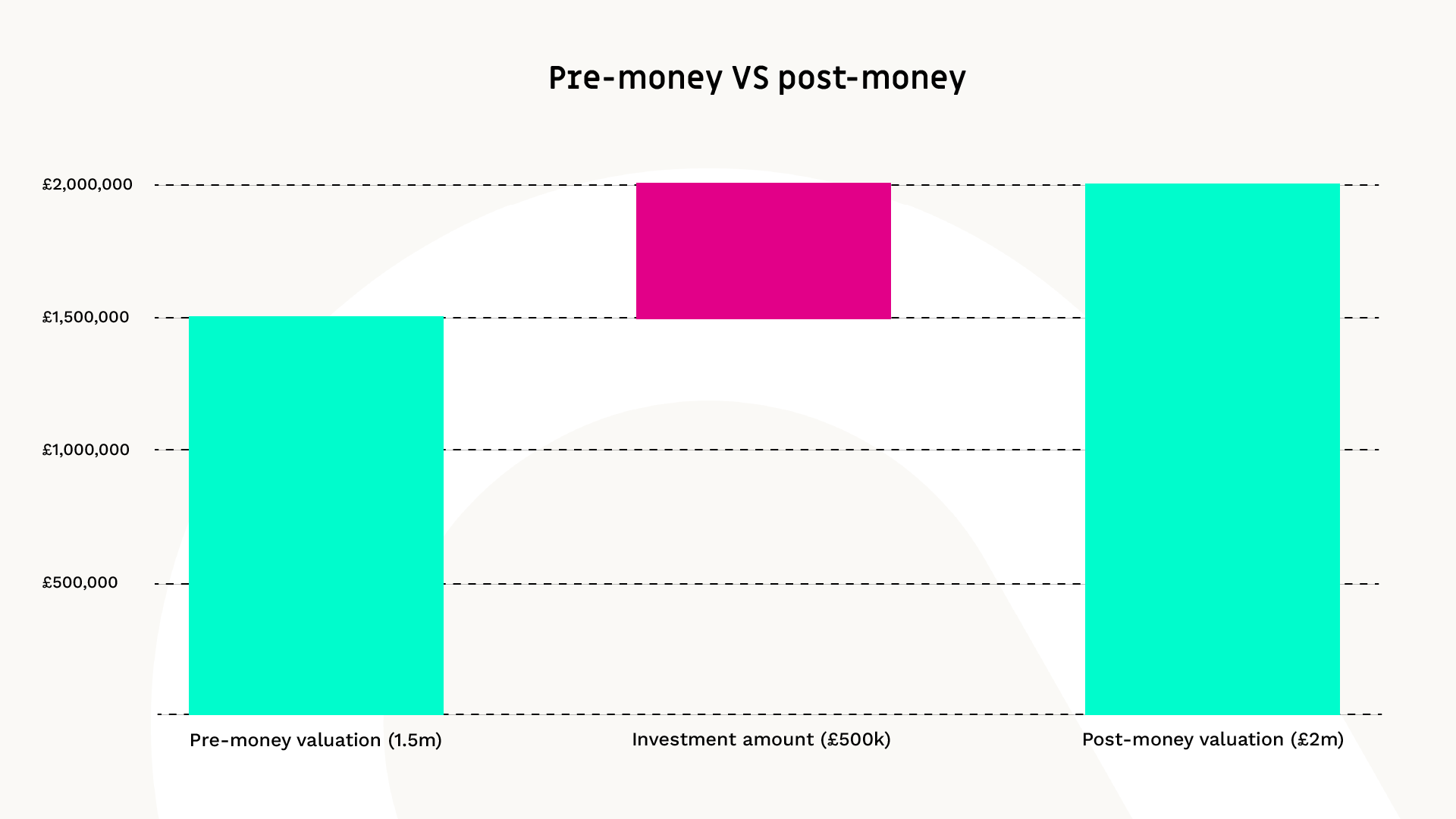
This is the valuation of your company before receiving new investment.
The value of your company after investment. It is calculated by adding the investment amount to the pre-money valuation. Although it is simple maths, it is critical in understanding equity dilution.
For example, if you were to raise £100k in exchange for 10% of your company, the implied post-money valuation would be £100k/0.1 = £1m.
This follows that the pre-money valuation is £1m-£100k = £900k.

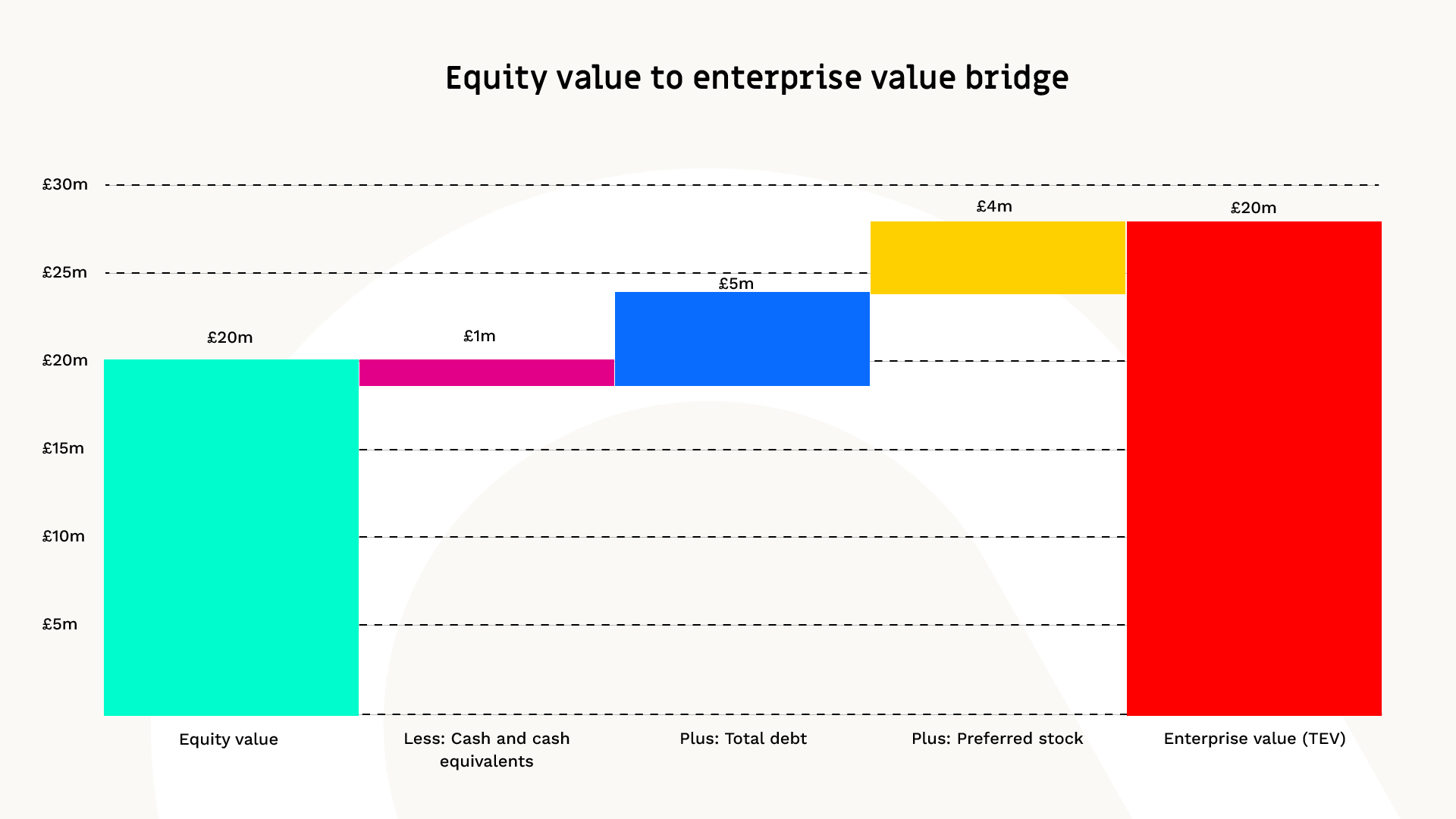
This focuses purely on the value of shareholder’s equity—essentially the total value of the company’s shares.
A more broad measure of your company’s worth, calculated by combining equity value and net debt. It is what investors use to assess the total value of your business.

A valuation method that estimates the value of a company, taking into account future cash flows and interest.
This is the process of comparing your business’ value to similar companies, using similar metrics as grounds of comparison. It generates a valuation ratio that can determine whether a business is being over or undervalued.
These two are implicated within one another, so it is useful to think of them as hand in hand. Your burn rate is the rate at which you are spending money.
Runway uses the established burn rate to decipher how long you can sustain operations before you run out of cash.
Both factors affect how investors view your financial health, and can determine whether they see their investment as viable and lasting.
Your cap table shows the breakdown of ownership of your company, and so maintaining a clean and clear one is essential for valuation discussions. Investors want to see exactly how their stake fits in with existing shareholders.
For dividend-paying companies, the Gordon Growth Model may be used to calculate company valuation through dividends. It does this by predicting future dividends at a constant growth rate, and discounting them to the present value.
This model is rarely used for early-stage businesses, but can be valuable for more mature companies.
The value of your company at the point of being sold or merged. Investors often use this to calculate potential returns.
Earnings Before Interest, Taxes, Depreciation, and Amortisation—this is a way to value a business that removes non-operational costs. This is handy in calculating its operating profit.
These metrics are widely used to gauge company valuation, by offering quick comparisons against other businesses in similar industries. These are specific methods that may be used in comparable company analysis.
PE Ratio = Share Price / Earnings Per Share (EPS)
EV/Revenue = Enterprise Value / Revenue
EV/EBITDA = Enterprise Value / EBITDA
This is a key metric used to evaluate the balance between growth and profitability, and is particularly used in SaaS companies. It’s calculated by adding your annual revenue growth rate to your EBITDA margin:
Rule of 40 = Revenue Growth (%) + EBITDA Margin (%)
A percentage of 40% or higher is ideal, as it shows the ideal trade off between operational efficiency and growth.
This is a way to value a startup using qualitative factors. It assigns a monetary value to aspects of your business such as idea, team, and market potential. This is particularly useful for pre-revenue startups, as it places value on potential.
The scorecard method benchmarks your startup against similar companies to determine its valuation. It assigns weights to various factors, such as product, team strength, and opportunity size. This can also be used when valuing a pre-money startup.
The asset-based approach calculates the valuation based on the value of its assets, either tangible (equipment, property) or intangible (patents, trademarks). This is particularly effective for companies with significant physical or intellectual property assets.
There are two common methods with this approach:
Company valuations can feel complicated, and the technical jargon only serves as a roadblock to some founders looking to undergo an important valuation.
Whether you're preparing for a funding round or planning your next big milestone, understanding these concepts will help you have more productive conversations with investors and advisors.
At Vestd, we’re here to help you navigate the ins and outs of fundraising and equity, to simplify your journey. Ready to take the next step? Let’s chat.
Valuing your business is one of the most important steps when seeking investment, offering equity to employees, or approaching an exit. Yet, many...
Settling on a valuation for your startup is an essential part of securing funding from investors.
Company valuations often make headlines - especially when businesses achieve multi-billion-pound valuations without turning a profit. But how exactly...