


Outside the M25: The regional growth story investors are missing
The UK's regional growth story points to investment opportunities beyond London, in ecosystems like Winchester and Cambridge. Read the full Scaleup...

Founders, finance and people teams all rely on the same equity record - we just give each of them the view they need.
Watch a demoA short walkthrough, end to end.
Migrate to VestdDigitise or move your existing scheme
EMI, growth shares, CSOP & more
ValuationsUK HMRC & US 409A valuations
Equity management & adminGovernance, admin & filings
Fundraising - InVestd RaiseApply for S/EIS & structure your round
PISCES / secondary marketsDeploy into regulated secondary trading
Your question is ready. Press Enter in the chat to send it.
Vestd AI isn't available right now
Please try again in a little while, or search our resources instead.
5 min read
Rebecca Appleton
:
Updated on November 5, 2026
A problem exists, and nobody knows exactly whose job it is. Who do you call? In many businesses, the answer is: the operations leader.
It may be a missing process, a stalled decision, or a task that slipped between departments. Someone needs to sort it out, and it usually ends up with operations.
Sometimes it’s a whole function. No marketing team for the product launch? Ops will take it for now. Head of People just left? The Head of Operations can handle it!
The Modern COO Benchmark 2026, commissioned by Vestd in partnership with Operations Nation, puts a number on this familiar situation: 74% of in-house operations leaders say work without a clear owner lands on their desk.
The research, based on 271 in-house leaders and a separate group of 22 fractional and portfolio operators, examines what the job involves and how much room there is to do it differently.
74% say that work without a clear owner will often land on their desk.
67% say firefighting is among the three biggest time demands.
72% want more time for strategic planning.
36% describe their relationship with the CEO or founder as a true strategic partnership.
72% say no part of their operations function is mostly or entirely run by AI.
58% work in organisations offering an employee share scheme.
Most respondents did not set out to become operations leaders: seven in ten grew into the role, often by taking on responsibilities that needed a home. For 64%, the job has since expanded beyond its original brief.
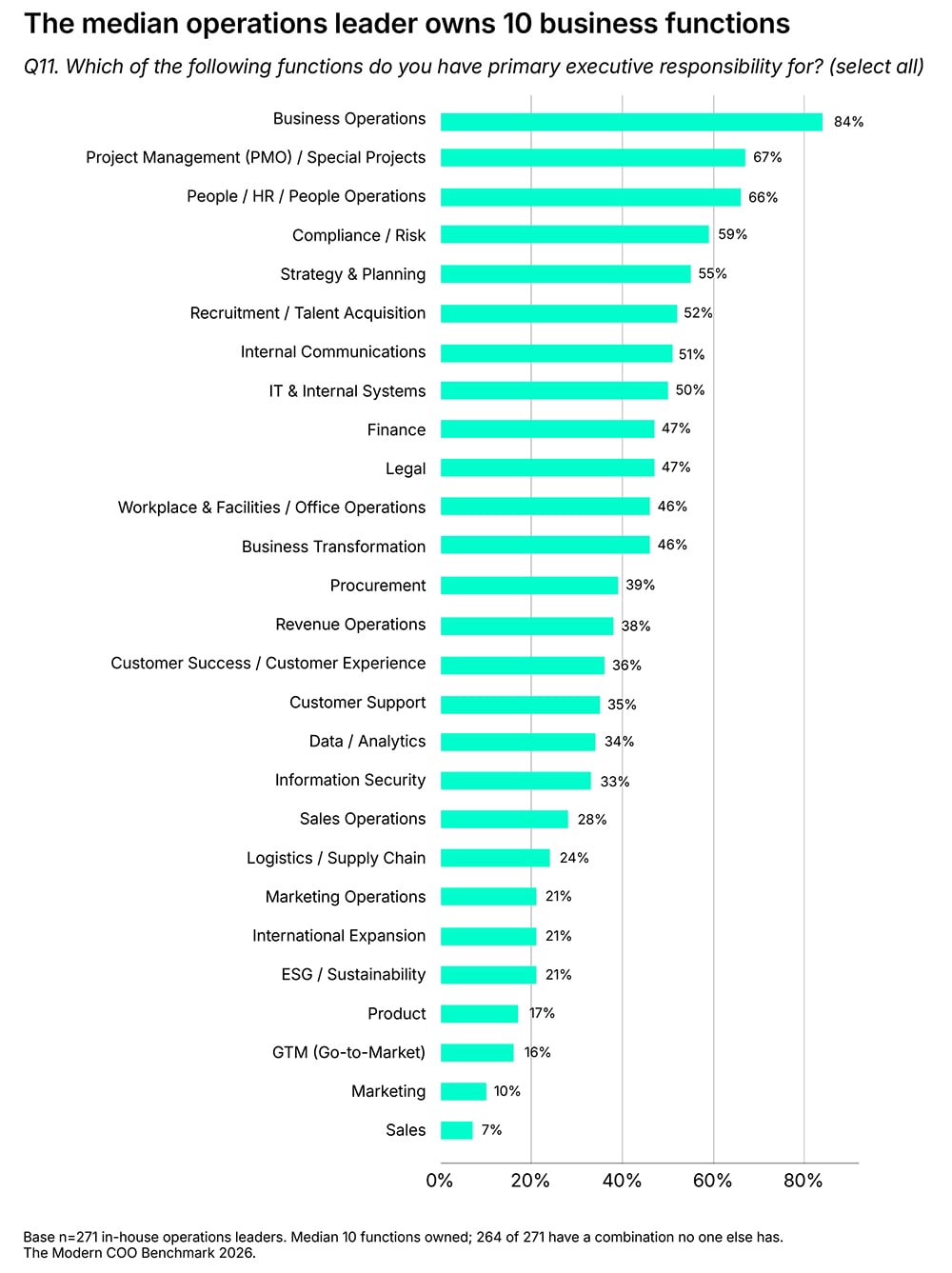
The median respondent now has primary responsibility for 10 of the 27 business functions covered by the survey. More than half (54%) oversee at least two of Finance, People and Legal.
It’s a scenario that’s very familiar to Aušrinė Keršanskaitė, Co-founder of Operations Nation. “My first task was to buy laptops for everyone,” she explains.
“My second was to file a trademark. I was an intern at a company just getting started. I didn’t know I was beginning a career in operations; I just did what needed doing. Within two years, I was Operations Director with a very broad remit. No map, but I learned as I went, and loved it.
“For nearly five years, I never met anyone with the same title. When the company was acquired, I couldn’t explain what I did or what an Operations Director role looked like elsewhere.
“The reason it matters is that it's very difficult to design, benchmark or properly value a role that we still struggle to describe. And when the boundaries of a role aren't clear, it becomes very easy for it to keep absorbing more.”
That breadth helps explain how the role expands. A task needs doing, so someone takes it on. A problem crops up in another department, and the same person steps in again. There may never be a formal decision to add these duties to the job description.
For those responsible for 16 or more functions, 71% say unclaimed work almost always becomes their responsibility. But how do you plan a week when job boundaries keep moving?
Operations can be a lonely seat. Join the ON Community to connect with peers who carry the same load.
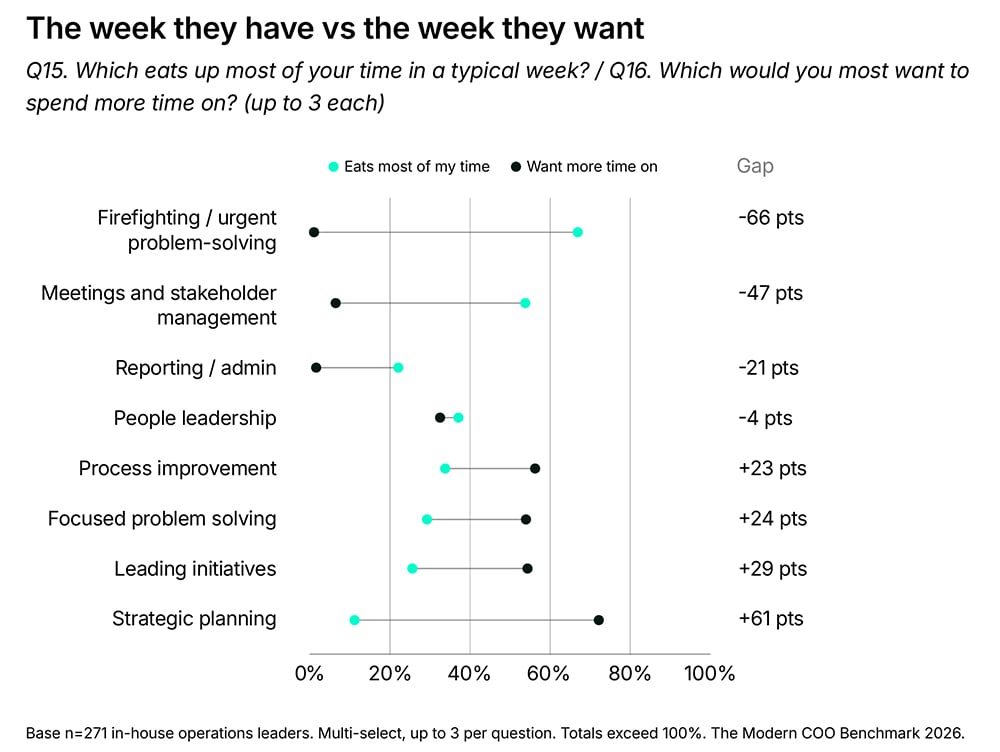
Firefighting is a major part of the week for 67% of respondents. By comparison, strategic planning is among the main weekly activities of only about one in nine, even though 72% would like more time for it.
The survey also asked about the biggest operational challenges. Too many competing priorities came top, selected by 54%. Manual work and low-value administration, along with pressure to deliver more with the same or fewer resources, each came in at 32%.
An operations leader can't solve all these problems alone. Others often set priorities, and extra responsibilities may arrive without anything being taken off the list. The result is a role with plenty of accountability - and little control over the demands placed on it.
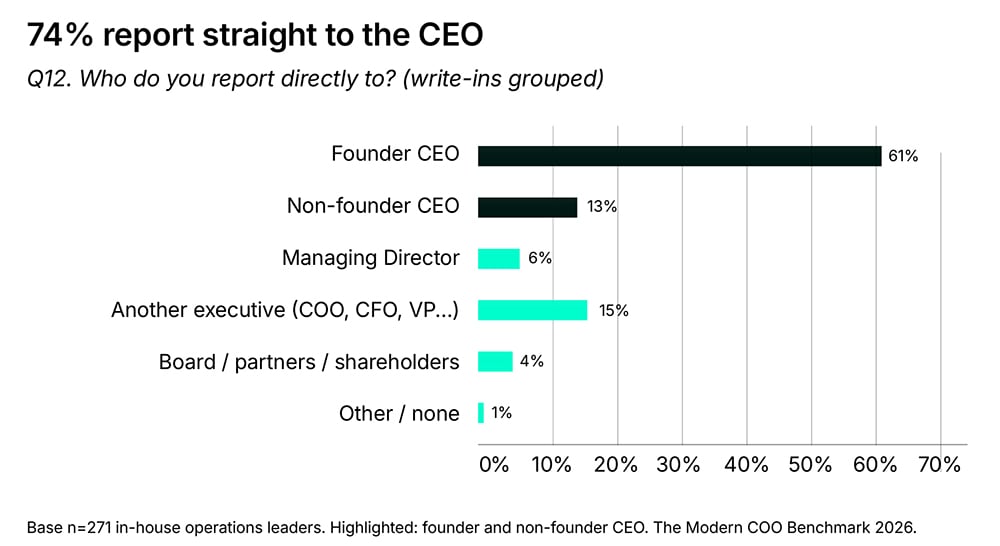
Most respondents report directly to the CEO (74%), yet just 36% describe the relationship as a true strategic partnership. Another 42% say they mainly turn the CEO’s ideas into an executable plan.
The two roles differ clearly: 50% of COOs report a true strategic partnership, versus 26% of Heads of Operations. This holds even after adjusting for company size, time in role, and area of responsibility.
Within smaller businesses (<51 employees), COO and Head of Operations may have very similar roles. What matters is whether they help shape decisions or are brought in after those decisions are made.
AI features among the top priorities or investments for 75% of respondents. But 72% say no part of their operations function is currently run entirely - or even mostly - by AI.
This is especially noticeable in professional services: 74% identify AI as a major investment, but only a fraction - 16% - say an operational area is mostly run by it.
When asked what they would do if AI saved them a full working day per week, 44% said they would use it for strategic tasks they don't have time for. 25% stated they would use it to get on top of their backlog. However, 26% stated it would be absorbed into other tasks or go unnoticed.
This is an important point when looking to increase efficiency: giving someone a tool to make one task quicker doesn’t mean their workload will decrease.
58% of respondents' organisations already offer employee share schemes. In 34% of cases, the scheme covers the full workforce; in 24%, it is restricted to senior or key team members. A further 8% are actively considering one.
For operations leaders whose responsibilities span several departments, introducing an employee share scheme can mean another project to coordinate. Yet 58% of organisations already offer one, suggesting that giving employees a stake in the business is part of the picture for many.
The benchmark raises a more immediate question, though:
How can operations leaders make time for work that matters when so much of their week is taken up by work that needs doing?
With responsibilities spreading across departments and strategic planning often pushed aside, the challenge goes beyond "getting everything done" - it's having the time and influence to decide what deserves attention in the first place.
Commenting on the findings, Ifty Nasir, CEO of Vestd, said:
"Every business has someone who holds the whole thing together, day after day. More often than not, it’s the operations leader.
“At Vestd, we help companies give their people a real stake in what they’re building. When a share scheme goes live, it’s usually the ops leader who makes it work. A scheme touches finance, people and legal, and 54% of ops leaders already own two or more of those areas.
“The trouble is, their best work often goes unnoticed, because success looks like nothing going wrong. That’s hard to set a target for. Time-based vesting rewards exactly this kind of contribution: sticking with it year after year, whether anyone sees the results or not.
“Their roles also keep growing beyond the original brief, and a stake in the business recognises what they actually carry, whatever their job title says.
"With 58% already working somewhere that offers a share scheme, this is a live question for many of them.”
If a share scheme is on your list, or already on your plate, we’re happy to talk it through. Book a free consultation with a specialist today.
An anonymous online survey in two versions: one for in-house operations leaders and one for fractional and portfolio operators.
Fieldwork ran from 16 July to 20 September 2026 (published close 18 September; five late responses included). We received 326 responses. We screened out 9 at the role question; 24 took the fractional survey, and 293 completed the main survey.
Of those 293, we excluded 8 who said they aren't involved in setting operational strategy or priorities, and 14 with out-of-scope job titles (CEOs, a CFO, a Chair, junior and former roles). That leaves a main sample of 271.
In the fractional survey, 2 were excluded on the same strategy question, leaving 22. Operations Nation and Vestd recruited respondents through their networks and on LinkedIn. 63% of organisations are UK-headquartered, and 58% have under 51 people.
48% of respondents name Operations Nation as one of their communities. The results describe this community of operations leaders well; they are not a census of the profession.
All data is accurate as of October 2026.
-
With special thanks to Operations Nation, Divinia Knowles FCMA, and the London COO Roundtable.
The UK's regional growth story points to investment opportunities beyond London, in ecosystems like Winchester and Cambridge. Read the full Scaleup...
I spotted some recent research from HMRC on Tax Advantaged Share Schemes (TASS). The report surveyed the opinions of employers, employees, and...
Vestd’s Remote Friendly Industries Study highlights which UK industries offer the most remote roles and how flexible work impacts both employees and...