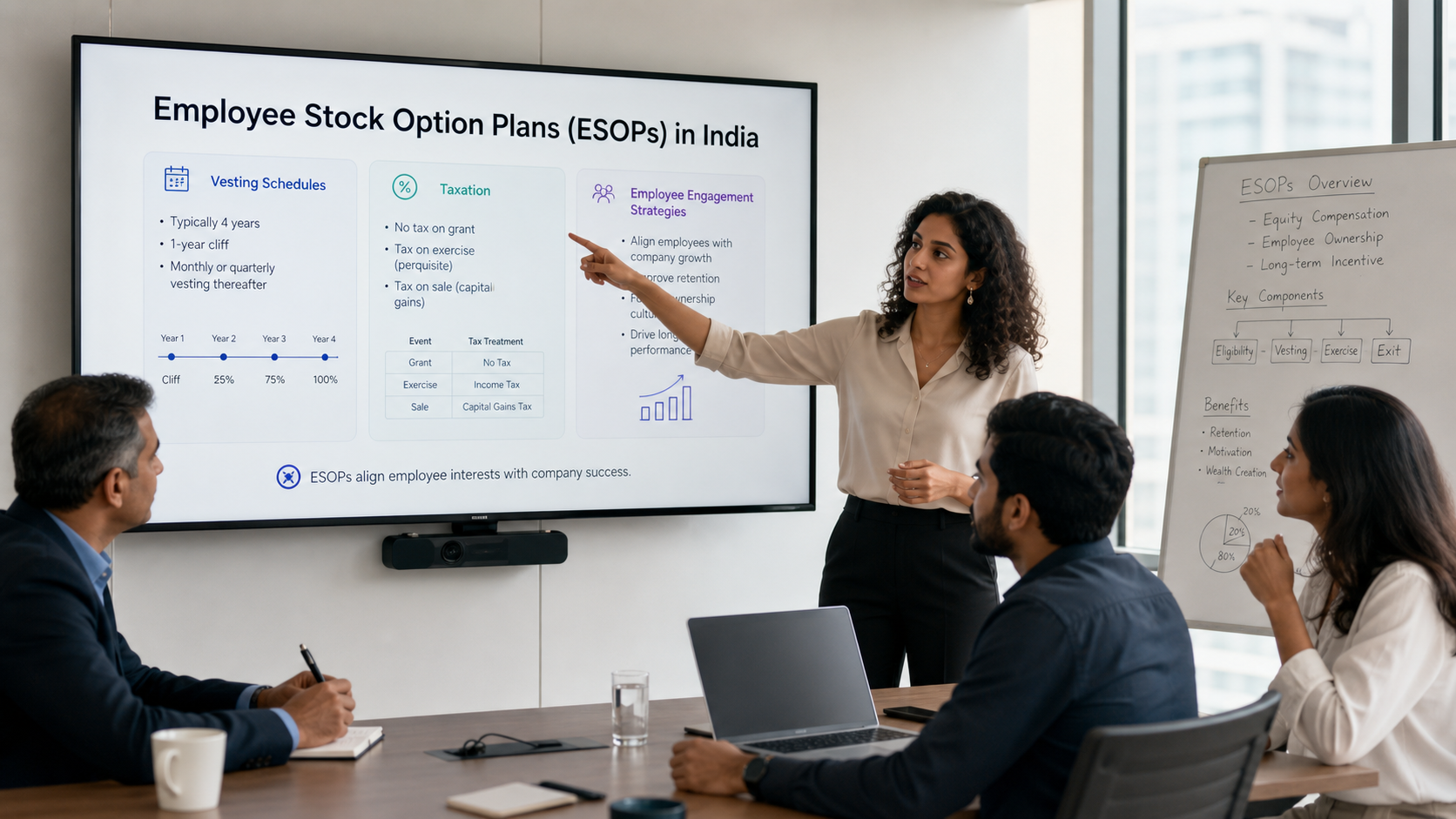
ESOPs: More than just an employee benefit
When people think about building a company, they often picture funding rounds, product launches, new customers and ambitious growth plans. Rarely do...
Table of Contents
Employee ownership in India has evolved from a startup perk into a strategic business tool.
In 2026, Employee Stock Option Plans (ESOPs) are no longer used solely to compensate for lower salaries or attract early employees. Companies across India now use employee ownership to improve retention, align incentives, strengthen company culture, and create long-term wealth for employees.
This shift has fundamentally changed the role of HR teams.
While legal and finance teams structure ESOPs, HR teams ultimately determine whether employees understand, value, and engage with ownership. As employee expectations around equity mature and investors demand stronger governance, HR leaders increasingly sit at the centre of employee ownership strategy.
This article explains how ESOPs work in India, why they matter for HR teams, and how organisations can build employee ownership programmes that create real business value.
ESOPs are important for HR teams because employee ownership is ultimately an employee experience challenge rather than a legal challenge.
Most employees do not join companies because they understand cap tables, dilution, or vesting schedules. They join because they believe in the opportunity to create meaningful long-term value. HR teams are responsible for translating complex ownership structures into something employees can understand and trust.
Consider the modern employee lifecycle.
HR teams introduce equity during recruitment, explain ownership during onboarding, answer questions about vesting and taxation, support employees during exits, and help maintain transparency throughout the ownership journey.
When employees do not understand their equity compensation, ESOPs lose much of their strategic value.
When employees do understand their ownership, companies often benefit from stronger retention, greater engagement, and improved alignment between employee performance and business outcomes.
At Vestd, one of the most consistent observations across employee ownership programmes is that understanding drives participation. Employees who understand their ownership are significantly more likely to view equity as part of their long-term financial planning rather than as an abstract employee benefit.
An Employee Stock Option Plan gives employees the right to purchase shares in their company at a predetermined price after meeting certain conditions, usually based on continued employment.
Importantly, employees do not receive shares immediately.
Instead, they receive the option to acquire shares in the future, subject to vesting conditions and company rules.
For example, imagine a senior software engineer joining a Series B technology company in Bengaluru. As part of her compensation package, she receives 20,000 stock options with an exercise price of ₹25 per share and a four-year vesting schedule.
On the day she joins, she owns no shares.
After one year of employment, a portion of her options vest, allowing her to purchase shares at the agreed exercise price. If the company's value increases significantly over time, those options may become one of the most valuable components of her overall compensation package.
This combination of risk, reward, and long-term alignment is what differentiates employee ownership from traditional compensation models.
|
1
|
Create the ESOP pool
Venture-backed companies typically reserve 10–20% of fully diluted share capital for employee ownership.
|
|
|
|
|
2
|
Grant options
Each grant specifies the number of options, exercise price, vesting schedule, exercise window and conditions.
|
|
|
|
|
3
|
Vesting
Most common: four-year vesting with a one-year cliff — 25% at the cliff, the rest monthly or quarterly.
|
|
|
|
|
4
|
Exercise
Employees purchase shares at the predetermined exercise price — and become shareholders.
|
|
|
|
|
5
|
Liquidity
Value is realised at an acquisition, listing, secondary transaction or company buyback.
|
Most ESOP programmes in India follow a similar lifecycle.
The first stage involves creating an ESOP pool. Venture-backed companies typically reserve between 10% and 20% of their fully diluted share capital for employee ownership, depending on their growth stage, hiring plans, and investor expectations.
The second stage involves granting options to employees. Each grant specifies the number of options awarded, the exercise price, vesting schedule, exercise window, and any applicable conditions.
The third stage is vesting.
The most common vesting structure in India remains four-year vesting with a one-year cliff. Under this model, employees typically receive no vested ownership during their first year of employment. Upon completing one year, employees often vest 25% of their grant, with the remaining amount vesting monthly or quarterly thereafter.
The fourth stage occurs when employees exercise their vested options by purchasing shares at the predetermined exercise price.
Finally, employees realise value when a liquidity event occurs, such as an acquisition, public listing, secondary transaction, or company buyback programme.
While this process appears straightforward in theory, managing employee ownership at scale requires careful coordination between HR, finance, legal, and leadership teams.
The growth of India's startup ecosystem has demonstrated the wealth creation potential of employee ownership.
One of the most widely discussed examples remains the acquisition of Flipkart by Walmart in 2018, which reportedly created substantial financial outcomes for thousands of employees. Since then, companies across India's technology ecosystem have continued to expand employee ownership programmes and liquidity opportunities.
Perhaps the most significant recent development has been the rise of employee buybacks and secondary transactions.
Historically, employees often had to wait for an IPO or acquisition to realise value from their ESOPs. Today, many private companies provide structured liquidity opportunities that allow employees to monetise portions of their holdings while continuing their employment.
This evolution has changed how employees evaluate equity compensation.
Rather than viewing ownership as a speculative long-term benefit, many employees increasingly consider equity as part of their broader wealth creation strategy.
For HR teams, this means employee ownership discussions are becoming more sophisticated and require greater transparency.
One of the biggest mistakes organisations make is attempting to distribute ownership without a clear strategic objective.
Effective employee ownership programmes are designed around business goals rather than perceptions of fairness alone.
Not: “Who deserves equity?”
“Where can ownership create the greatest long-term value for both employees and the business?”
Early-stage startups often allocate meaningful ownership to founding employees who accepted greater risk during the company's formative years. Growth-stage companies frequently use equity to attract critical hires, including senior engineers, product leaders, executives, and specialist talent.
As companies mature, some organisations choose to expand ownership more broadly across the workforce to strengthen organisational alignment and build ownership culture.
The answer will vary depending on the company's stage, hiring strategy, and growth ambitions.
There is no universal ESOP pool size.
However, most companies in India fall within established ranges based on their stage of growth.
| Company stage | Typical pool (fully diluted) |
| Early-stage startups | 10–15% |
| Venture-backed growth companies | 10–20% |
| Later-stage private companies | 5–10% |
Employee ownership decisions are not simply compensation decisions they are ownership and governance decisions.
Early-stage startups commonly establish pools between 10% and 15% of fully diluted share capital. Venture-backed growth companies often maintain pools between 10% and 20%, while later-stage private companies may operate with smaller pools ranging from 5% to 10%.
Determining the appropriate pool size requires balancing competing priorities. A larger ESOP pool provides greater flexibility for future hiring and retention. However, it also increases dilution for founders and existing shareholders.
For example, a founder owning 60% of a business may experience substantial dilution after creating an employee ownership pool and completing several funding rounds.
This is why ownership modelling and cap table forecasting have become increasingly important as companies scale.
Most employees do not ignore equity because they lack interest.
They ignore equity because companies often fail to explain ownership in practical terms.
| What do I actually own? | What could it realistically be worth? |
| What happens if I leave the company? | How does dilution affect me? |
| When can I sell my shares? | How much tax might I owe? |
If your programme can’t answer these in plain language, legal agreements and spreadsheets won’t fill the gap.
Unfortunately, many organisations attempt to answer these questions using legal agreements and spreadsheets.
These tools satisfy compliance requirements but rarely create employee confidence.
|
Scenario one
A grant letter full of legal terminology and vesting schedules. The employee signs it — and never revisits it. |
Scenario two
Educational resources, ownership dashboards, scenario modelling and regular communication about their equity. |
The ownership structure is identical. The employee experience is completely different.
This is why employee education has become one of the most important aspects of ESOP management. Companies seeking to improve ownership understanding should consider implementing structured communication programmes, ownership education sessions, and transparent employee dashboards.
For a deeper exploration of ownership communication strategies, see our guide on explaining ESOPs to employees effectively.
ESOP taxation in India generally occurs at two separate stages.
|
1 · At exercise
FMV minus exercise price is a taxable perquisite under salary, e.g. ₹500 FMV at a ₹50 exercise price means ₹450 per share is taxable. Salary income
|
2 · At sale
Any increase in value between acquisition and sale is subject to capital gains taxation. Capital gains
|
Tax may be owed before liquidity arrives — and certain DPIIT-recognised startups may qualify for deferral. Work closely with finance and tax professionals when designing your programme.
This dual taxation structure can create significant cash flow challenges because employees may owe tax before receiving liquidity from their shares.
Certain DPIIT-recognised startups may qualify for deferred taxation provisions under current regulations, which can significantly improve the employee ownership experience.
As taxation rules continue to evolve, HR teams should work closely with finance and tax professionals when designing employee ownership programmes.
As businesses grow, managing equity becomes significantly more complex. Funding rounds, ESOP grants, vesting schedules, shareholder approvals, buybacks, investor servicing and regulatory compliance all introduce operational complexity that quickly outgrows manual processes.
For this reason, many startups and private companies adopt dedicated ESOP and equity management platforms. Some of the most well-known platforms in India include Vestd, Qapita, Hissa and EquityList. While each solution helps companies manage employee equity and cap tables, the right choice depends on your company's size, governance requirements and long-term growth plans.
Vestd combines modern equity management software with Registrar & Transfer Agent (RTA) services, giving companies a single platform to manage cap tables, issue and administer ESOPs, maintain shareholder records, automate corporate actions and support founders, investors and employees throughout the ownership lifecycle.
As ownership structures become more sophisticated, businesses increasingly recognise that a dedicated equity platform provides greater transparency, stronger governance, improved compliance and a reliable single source of truth for all ownership data.
Employee ownership in India is entering a new phase of maturity. Employees increasingly expect visibility, education, and access to liquidity. Investors expect stronger governance, cleaner ownership records, and greater operational discipline. Companies are recognising that ownership is not simply a compensation mechanism but a strategic business tool.
For HR leaders, this creates a significant opportunity.
The organisations that build effective employee ownership programmes today will not simply attract better talent. They will create stronger alignment, deeper engagement, greater trust, and more resilient businesses. Ultimately, the most successful ESOP programmes do not merely distribute equity. They create owners.
If you're still relying on disconnected tools or manual workflows, it may be time for a better solution. Explore how Vestd helps startups and private companies streamline equity management with powerful software and expert RTA support.
Streamline equity management with powerful software and expert RTA support one platform for cap tables, ESOPs and shareholder records.
Schedule your guided demo →
When people think about building a company, they often picture funding rounds, product launches, new customers and ambitious growth plans. Rarely do...
Employee share options have created millionaires, rewarded early believers, and helped some of the world's fastest-growing companies attract...
For many growth-stage companies, preparing for an initial public offering (IPO) is far more than a capital-raising exercise. It marks the transition...