



4 min read

ESOP taxation in India: The complete guide (2026)

ESOP taxation in India: The complete guide (2026)

Ask ten employees when ESOPs are taxed and chances are most will answer:"When I sell my shares." It's one of the biggest misconceptions around Employee Stock Ownership Plans. In reality, ESOPs in India are generally taxed twice.The first tax can arise before you've earned a single rupee from your shares. The second comes only when you eventually sell them.

This surprises many employees, particularly in startups where liquidity events may be years away. Founders often assume issuing ESOPs is the difficult part. In reality, explaining the tax implications clearly is often even more challenging.

Whether you're a founder building an ESOP policy, an HR leader answering employee questions, or an employee trying to understand what your equity is really worth, this guide has you covered. We'll break down ESOP taxation in India for 2026 with practical examples, simple explanations and answers to the questions people ask most—so you leave with complete clarity.

Understanding the ESOP journey

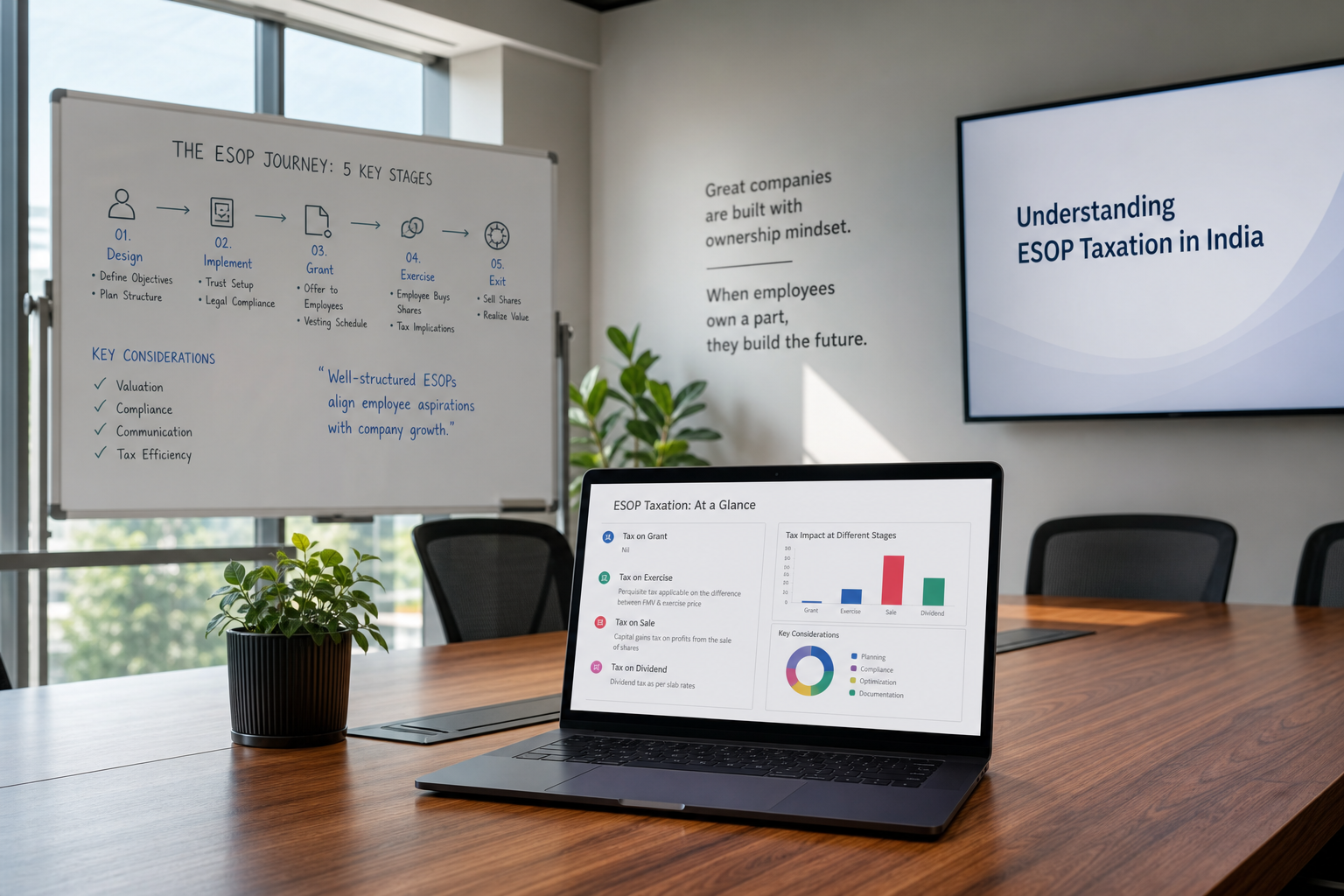
Think of an ESOP as a journey rather than a single event. There are five important stages.

The ESOP journey

Five stages and where tax kicks in

Tax only arises at two of the five stages: exercise and sale.

1
Grant
You receive the right to buy shares later. You don’t own shares yet.
No tax
 
   
2
Vesting
Options become exercisable over time. Vesting itself does not trigger tax which is a common myth.
No tax
 
   
3
Exercise
You buy your vested shares at the exercise price. The discount is treated as a salary perquisite.
Taxed
 
   
4
Holding the shares
You simply own the shares. No tax arises merely from continuing to hold them.
No tax
 
   
5
Selling the shares
The second taxable event, this time as capital gains, not salary.
Taxed

Why are ESOPs taxed twice?

This is one of the most common questions employees and founders ask and one of the most misunderstood aspects of ESOP taxation in India. The simple answer is that the government views your ESOP journey as two separate financial events.

Two separate events

Why ESOPs are taxed twice

At exercise
Discount from employer

Buy a ₹500 share for ₹100 — the ₹400 benefit is given by your employer.

Taxed as Salary
At sale
Growth as a shareholder

Shares rise to ₹900 — the further ₹400 gain is an investment return, not employment income.

Taxed as Capital Gain

What is Fair Market Value (FMV)?

FMV simply means the value of one share on the exercise date. For listed companies, this is the average of opening price and closing price of the share on the exercise date. For unlisted companies, FMV is generally determined through a valuation carried out by a registered merchant banker using accepted valuation methodologies.

Worked example

Priya’s two tax events

2,000 ESOPs · exercise price ₹80 · FMV at exercise ₹350 · later sold at ₹700.

1 · At exercise — Perquisite (Salary)
FMV per share ₹350
Less: exercise price − ₹80
Gain per share ₹270
× 2,000 shares ₹5,40,000
₹5,40,000 is taxed as salary even though Priya hasn’t sold a single share or received any cash. This cash-flow mismatch is one of the biggest ESOP challenges.
2 · At sale — Capital Gains
Sale price per share ₹700
Less: FMV at exercise − ₹350
Capital gain per share ₹350
× 2,000 shares ₹7,00,000
Only the appreciation after exercise is taxed here. The exercise price isn’t used again, the FMV at exercise is the cost of acquisition, so the same amount is never taxed twice.

Why ESOP taxation matters for founders

Many founders view ESOP taxation as an employee issue. In reality, it can have a significant impact on hiring, retention, employee satisfaction and even the perceived value of your equity programme.

An ESOP is only valuable if employees understand it and feel confident participating in it. When employees are surprised by tax obligations, the ownership culture founders are trying to create can quickly become a source of confusion and frustration.

Why it matters for founders

Five reasons tax clarity pays off

1

Surprises reduce perceived value

Tax at exercise with no sale or cash, can make equity feel like a burden rather than an opportunity.

2

Tax worry delays exercise

Uncertainty over how much, when, and whether it’s worth it is a top reason employees hesitate.

3

Tax education builds trust

Transparency around equity a real part of total comp strengthens the employer relationship.

4

Understanding aids retention

Employees value and keep equity when they grasp its long-term potential, not just today’s salary.

5

Investors expect mature practices

As you scale, investors assess how well the ESOP vesting, windows, liquidity, tax is managed.


ESOP taxation for startup employees

Startup ESOPs often create unique challenges because employees may face taxes before they have an opportunity to sell shares. To address this issue, special provisions were introduced for employees of eligible startups.

DPIIT-recognised startups

Tax on ESOP perquisites may be deferred

For employees of eligible startups, the perquisite tax becomes payable at the earliest of:

Sale of the shares
The employee leaving the company
Expiry of the prescribed deferral period under applicable tax rules

Confirm whether your company qualifies and seek professional tax advice where necessary.

Listed vs unlisted company ESOP taxation

Although the overall taxation framework remains similar, there are important differences. Understanding whether your company is listed or unlisted significantly affects tax planning and liquidity expectations.

Company type matters

Listed vs unlisted ESOP taxation

Factor Listed Unlisted
FMV determination Market price Merchant banker valuation
Liquidity Typically higher Typically lower
Holding period for long-term classification Generally shorter Generally longer
Price transparency High Lower
Tax planning complexity Lower Higher

What happens to ESOPs when you leave the company?

This is one of the most common employee concerns. The answer depends on the company's ESOP policy.

If you leave

What happens to your ESOPs

Unvested options

Generally lapse when employment ends.

Vested options

You may get a limited exercise window after leaving. If unused within that window, they may lapse.

Before exercising after leaving, weigh the exercise cost, potential tax liability, likelihood of future liquidity and the company’s prospects.

Tax implications

Employees considering exercise after leaving should evaluate:

  • Exercise cost
  • Potential tax liability
  • Likelihood of future liquidity
  • Company performance prospects

Understanding these factors can prevent costly mistakes.


How Vestd India helps companies simplify ESOP taxation

Taxation is one of the biggest reasons employees hesitate to engage with their ESOPs. The rules are technical, timelines matter, and missing a compliance step can lead to costly mistakes.

Vestd India helps founders, finance teams and HR leaders simplify equity management through a single platform that supports ESOP administration from grant to vesting, cap table management, employee communications and compliance workflows. By giving employees greater visibility into their equity, companies can spend less time explaining spreadsheets and more time building an ownership culture.

Make ESOPs easier to manage

Vestd India supports ESOP administration from grant to vesting cap tables, employee communications and compliance workflows, all in one place.

Schedule your guided demo →
What ESOPs conversations are revealing about the future of employee ownership

What ESOPs conversations are revealing about the future of employee ownership

Two cities, one recurring theme: employee ownership is maturing, but employee expectations are evolving even faster Over the past few months, our...

Read More
Why ESOPs are a smart growth strategy for fast-growing companies

Why ESOPs are a smart growth strategy for fast-growing companies

Employee Stock Ownership Plans (ESOPs) are no longer just a compensation tool. For startups and high-growth businesses, they have become one of the...

Read More
ESOPs: More than just an employee benefit

ESOPs: More than just an employee benefit

When people think about building a company, they often picture funding rounds, product launches, new customers and ambitious growth plans. Rarely do...

Read More